Matt C. Abbott column
A pro-life economic agenda
Matt C. Abbott
Matt C. Abbott
November 5, 2010
November 5, 2010
Morally speaking, there can be no compromise when it comes to protecting the unborn from death through abortion. Period. That said, I'm no expert in the subjects of economics and philosophy; I'm a student in that regard. Consider this material "food for thought." I recently received the following (edited) e-mail from Michael D. Greaney, CPA, MBA, director of research for the Center for Economic and Social Justice: 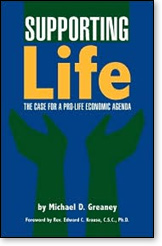 Although our graduations are separated by time, and our colleges by subject, both the author of this book and I are graduates of the University of Notre Dame du Lac in South Bend, Indiana. We are connected in other ways as well. We both write for Social Justice Review, the editorship to which I succeeded on the death of our mutual friend, the late and very much lamented Father John H. Miller, C.S.C., S.T.D. In addition, we both serve on boards of the Center for Economic and Social Justice ("CESJ"), a non-profit think tank in Arlington, Virginia; I on the Board of Counselors, and Mr. Greaney on the Board of Directors. Mr. Greaney and I share something else: a concern for the integrity and reputation of our alma mater. Both of us believe this may have been seriously damaged in May of 2009. It was then that Father John Jenkins, C.S.C., president of Notre Dame, bestowed an honorary degree on U.S. President Barack Obama following the issuance of a directive that no Catholic university was to bestow honors on politicians supporting a right to abortion. Whatever your opinion of Father Jenkins's action, this book responds to Mr. Obama's call during his speech at Notre Dame for "common ground" on which Pro-Life and Pro-Choice adherents can meet and come to some peaceful resolution. I believe that Mr. Greaney's suggestions in this regard merit serious consideration. By "common ground," of course, we mean a common acceptance of the basic principles on which society is based. It does not mean that we necessarily accept someone else's interpretation or application of those principles — that is where the debate occurs, in the realm of politics, not morals. Mr. Greaney's analysis is divided into five parts. The first part is an examination of the natural law as the foundation of a just social order. The second part is an admitted amateur's opinion of the constitutionality of the right to an abortion established by Roe v. Wade viewed from within the natural law context that provides the basis of the U.S. government. The third takes the presumed right of choice and draws some logical conclusions. The fourth part introduces us to what many people might consider a new way of looking at social action: social justice. The fifth part offers a possible Pro-Life economic agenda to remove many of the root causes of the conflict. The third part of this book is based on what some people may regard as a dangerous concession to the Pro-Choice position: the acknowledgment that the United States Supreme Court considers abortion a constitutionally protected right. As a professor of moral philosophy, "ethics," I can assure anyone troubled by these or similar considerations that acknowledging reality in no way violates a "well-formed conscience," nor in any way constitutes a concession. On the contrary, St. Thomas Aquinas — considered a "sure guide" by the Catholic Church and whose Aristotelianism is shared by the Jewish philosopher Moses Maimonides and the Islamic scholar Ibn Khaldûn — tells us that we must accept and obey even the most egregiously unjust law if we personally are not forced to do that which we regard as evil, and if the result of disobedience or even changing the law would seriously disrupt the social order. We cannot, however, stop there. The social doctrine of Pius XI as analyzed by Father William Ferree refines our understanding of the proper course of action in the face of injustice. When society is badly organized — and unjust laws are certainly evidence of that! — and correcting the situation is beyond our individual capacities, there is recourse. That is to organize with like-minded others and work to reform the institutions of the common good. Once we have reformed our institutions by means of these acts of "social virtue," acts of individual virtue become possible. The goal of social justice is not to replace individual virtue, but to enable it. Nor can we stop there, either. We must replace bad or defective institutions with institutions better adapted to assist each human being to acquire and develop virtue, that is, to become more fully human. Traditionally, within civil society our capacity to acquire and develop virtue, as well as the best protection for each person's inalienable rights to life and liberty, has been access to the means of acquiring and possessing private property in the means of production. Our growing dependency on the State and our acquiescence in unjust laws and institutions will only be broken when each human person can become an owner not only of his or her own labor, but of capital as well. I should make it clear that CESJ is not a Catholic, nor even a religious organization. CESJ was founded to promote understanding of the social doctrine of Pope Pius XI and the economic justice principles of Louis O. Kelso and Mortimer J. Adler. The former is as analyzed by Father William J. Ferree, S.M., Ph.D., a CESJ co-founder, while the latter provides the basis for "binary economics." Both are founded on the inherent dignity of the human person before God. Economic and social justice are essential supports of individual sovereignty, albeit realized within a social context. Human dignity and personal sovereignty are both based solidly on the natural law, the principles of which are common to all the great religions and philosophies. Read this book and reflect on its proposals, with special emphasis on "Capital Homesteading." Then consider in what way you might be able to assist in advancing this "Just Third Way" beyond both capitalism and socialism. A visit to the website of the Center for Economic and Social Justice, www.cesj.org, would be a good place to start.
Although our graduations are separated by time, and our colleges by subject, both the author of this book and I are graduates of the University of Notre Dame du Lac in South Bend, Indiana. We are connected in other ways as well. We both write for Social Justice Review, the editorship to which I succeeded on the death of our mutual friend, the late and very much lamented Father John H. Miller, C.S.C., S.T.D. In addition, we both serve on boards of the Center for Economic and Social Justice ("CESJ"), a non-profit think tank in Arlington, Virginia; I on the Board of Counselors, and Mr. Greaney on the Board of Directors. Mr. Greaney and I share something else: a concern for the integrity and reputation of our alma mater. Both of us believe this may have been seriously damaged in May of 2009. It was then that Father John Jenkins, C.S.C., president of Notre Dame, bestowed an honorary degree on U.S. President Barack Obama following the issuance of a directive that no Catholic university was to bestow honors on politicians supporting a right to abortion. Whatever your opinion of Father Jenkins's action, this book responds to Mr. Obama's call during his speech at Notre Dame for "common ground" on which Pro-Life and Pro-Choice adherents can meet and come to some peaceful resolution. I believe that Mr. Greaney's suggestions in this regard merit serious consideration. By "common ground," of course, we mean a common acceptance of the basic principles on which society is based. It does not mean that we necessarily accept someone else's interpretation or application of those principles — that is where the debate occurs, in the realm of politics, not morals. Mr. Greaney's analysis is divided into five parts. The first part is an examination of the natural law as the foundation of a just social order. The second part is an admitted amateur's opinion of the constitutionality of the right to an abortion established by Roe v. Wade viewed from within the natural law context that provides the basis of the U.S. government. The third takes the presumed right of choice and draws some logical conclusions. The fourth part introduces us to what many people might consider a new way of looking at social action: social justice. The fifth part offers a possible Pro-Life economic agenda to remove many of the root causes of the conflict. The third part of this book is based on what some people may regard as a dangerous concession to the Pro-Choice position: the acknowledgment that the United States Supreme Court considers abortion a constitutionally protected right. As a professor of moral philosophy, "ethics," I can assure anyone troubled by these or similar considerations that acknowledging reality in no way violates a "well-formed conscience," nor in any way constitutes a concession. On the contrary, St. Thomas Aquinas — considered a "sure guide" by the Catholic Church and whose Aristotelianism is shared by the Jewish philosopher Moses Maimonides and the Islamic scholar Ibn Khaldûn — tells us that we must accept and obey even the most egregiously unjust law if we personally are not forced to do that which we regard as evil, and if the result of disobedience or even changing the law would seriously disrupt the social order. We cannot, however, stop there. The social doctrine of Pius XI as analyzed by Father William Ferree refines our understanding of the proper course of action in the face of injustice. When society is badly organized — and unjust laws are certainly evidence of that! — and correcting the situation is beyond our individual capacities, there is recourse. That is to organize with like-minded others and work to reform the institutions of the common good. Once we have reformed our institutions by means of these acts of "social virtue," acts of individual virtue become possible. The goal of social justice is not to replace individual virtue, but to enable it. Nor can we stop there, either. We must replace bad or defective institutions with institutions better adapted to assist each human being to acquire and develop virtue, that is, to become more fully human. Traditionally, within civil society our capacity to acquire and develop virtue, as well as the best protection for each person's inalienable rights to life and liberty, has been access to the means of acquiring and possessing private property in the means of production. Our growing dependency on the State and our acquiescence in unjust laws and institutions will only be broken when each human person can become an owner not only of his or her own labor, but of capital as well. I should make it clear that CESJ is not a Catholic, nor even a religious organization. CESJ was founded to promote understanding of the social doctrine of Pope Pius XI and the economic justice principles of Louis O. Kelso and Mortimer J. Adler. The former is as analyzed by Father William J. Ferree, S.M., Ph.D., a CESJ co-founder, while the latter provides the basis for "binary economics." Both are founded on the inherent dignity of the human person before God. Economic and social justice are essential supports of individual sovereignty, albeit realized within a social context. Human dignity and personal sovereignty are both based solidly on the natural law, the principles of which are common to all the great religions and philosophies. Read this book and reflect on its proposals, with special emphasis on "Capital Homesteading." Then consider in what way you might be able to assist in advancing this "Just Third Way" beyond both capitalism and socialism. A visit to the website of the Center for Economic and Social Justice, www.cesj.org, would be a good place to start. Rev. Edward Krause, C.S.C., Ph.D.
Professor of Moral Philosophy
Gannon University, Erie, Pennsylvania
Professor of Moral Philosophy
Gannon University, Erie, Pennsylvania
Matt C. Abbott is a Catholic columnist with a Bachelor of Arts degree in Communication, Media and Theatre from Northeastern Illinois University in Chicago, and an Associate in Applied Science degree in Business Management from Triton College in River Grove, Ill. He has worked in the right-to-life movement and is a published writer focused on Catholic and social issues. He can be reached at mattcabbott@gmail.com
http://www.renewamerica.com/columns/abbott/101105